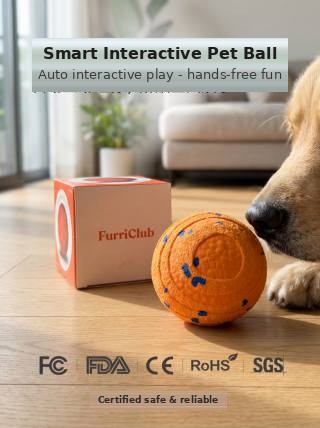
Most dog toys are bought once and forgotten. Interactive toys are different: they are the ones customers come back to ask about, because the dog actually plays with them instead of ignoring them after a day. For a pet store, that repeat conversation is the whole point. A customer who buys a ball their dog loves will trust your next recommendation too.
The mistake is stocking interactive toys like ordinary toys — a shelf of round objects in different colours, with nothing to tell them apart. Interactive toys sell on what they do, not what they look like. This guide covers the four types worth stocking, what to check before you order, and how to build a small range that earns its shelf space.
1. Four types that actually earn the name interactive
Start with the moving ball. A smart ball that rolls and changes direction on its own gives a dog something to chase even when nobody is free to play. Our ETPU Smart Pet Ball (PL001) works this way: the ball moves, the dog follows, and the game never needs a second person. It is the hero of the range, and the easiest one to demonstrate — put it on the floor and let the customer watch their dog react.
Second, the tug toy. Tug is the oldest interactive game there is, and it is a two-player game: dog and owner, or dog and dog. Our Titan Tug Ring (PL024) is built for it — a ring the dog can grip and pull without the owner hurting their hands. Tug toys sell to the customer who plays with their dog every day, and they wear out faster than most toys, which means repeat sales.
Third, the chew-and-chase ball. Not every customer wants a ball with moving parts. Some want a tough ball their dog can bite, carry and chase, indoors or out. Our ETPU Tug-of-War Ball (PL027) and ETPU Candy Ball (PL028) cover this slot: solid, grippy, and shaped for a dog's mouth rather than a shelf display. They are the everyday sale — cheap enough to be an add-on, tough enough to be remembered.
Fourth, the teaser and chase toy. Some dogs are driven by movement more than by chewing, and a toy that darts, spins or teases keeps them engaged longer than a ball they can hold still. Stock one chase-style toy for the high-energy dog, and sell it to the owner whose dog destroys ordinary toys out of boredom, not aggression.
2. What to check before you order: material, size and parts
Material comes first. A toy that looks tough in a photo and splits on the first afternoon will cost you a return and a customer. For chew and tug toys, look at the material and the seams: ETPU and other dense, flexible materials take biting better than hard plastic, which can crack, or thin rubber, which can tear. Ask your supplier what the toy is made of, and test one yourself before you order in volume.
Size comes second, and it is the check most stores skip. Match the toy to the dog's jaw and strength, not just its weight. A ball a small dog cannot pick up is useless; a ball a large dog can fit entirely in its mouth is dangerous. Stock at least two sizes where the product allows it, and train staff to ask the dog's breed and chewing strength before recommending a size. When in doubt, size up and let staff guide the customer.
Parts come third. Any toy with a switch, a charging port, a battery cover or a detachable piece needs a closer look. Can the cover come loose during play? Can a determined chewer reach the electronics? For a moving ball, check how it charges and how it is switched on and off — the customer will ask, and staff should have done it themselves at least once. If a part looks like it could be bitten off, say so honestly and steer the customer to a tougher option.
3. Building the assortment: four slots cover the category
A practical starter range needs only four slots. First, one moving ball as the hero — the product the display is built around. Second, one tug ring for the daily player. Third, one or two chew-and-chase balls at an everyday price, in two sizes. Fourth, one chase-style toy for the high-energy dog.
Keep the range small on purpose. Dog toys are a category where twenty similar balls confuse the customer and slow the sale. Four clear choices — a ball that moves, a ring for tugging, a ball for chewing, and a toy for chasing — let staff explain the difference in one sentence each, and let the customer pick by how their dog plays, not by colour.
Put the hero ball where it can move. A moving ball in a box is a dead product. If you can, run it on the shop floor for a few minutes a day, or keep a short video loop beside the display showing a dog chasing one. Customers buy interactive toys with their eyes first: they need to see the toy doing something, not read a description of it.
4. Selling interactive toys alongside the rest of the dog range
Interactive toys sell best next to the products the same customer already buys — treats, chews and training aids. A customer buying a tug ring is a customer who plays with their dog; the same customer buys treats for training and a sturdy lead for walks. Place the chew balls near the treats, and the hero ball at the end of the same aisle, so the small sale leads naturally to the bigger one.
Test-sell before you commit to volume. Pick two or three lines, give them a fixed test period on the shelf, and reorder only what actually moves. Watch which type sells: if the tug rings go first, your customers are players; if the chew balls go first, they are chewers. That tells you what to expand next time, and it tells you how your supplier performs in practice — how fast they confirm orders, how accurately they pack, and how they respond when something goes wrong.
Train staff on one line each: the moving ball plays by itself, the tug ring plays together, the chew ball survives the daily game, and the chase toy tires out the energetic dog. That distinction is the whole pitch, and it is short enough to remember on a busy Saturday.
Want the full range before you decide? Browse our wholesale toys — including the ETPU Smart Pet Ball (PL001), Titan Tug Ring (PL024), ETPU Tug-of-War Ball (PL027) and ETPU Candy Ball (PL028) — or request a quote and tell us which models you want priced. Pricing and MOQ are available on request.