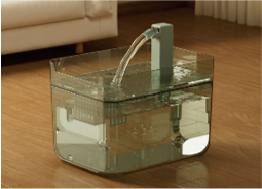
Cat water fountains are one of the easiest upgrades a pet store can sell. A customer walks in to replace a bowl, sees moving water, and walks out with a product that costs several times more than the bowl they came for. The fountain solves a problem the customer already understands — cats often ignore still water — and it does it visibly, right on the shelf.
For a retailer, the category is attractive for a different reason: fountains are a repeat-purchase ecosystem, not a one-off sale. Filters, replacement parts and second units for multi-cat homes all bring the same customer back. This guide covers the designs, materials and buying decisions that matter before you stock them.
1. Why fountains sell: moving water beats a still bowl
Cats are drawn to running water. Many will drink from a tap while ignoring a full bowl beside it, and owners notice. A fountain gives the cat that moving water at home, and it gives the owner a reason to believe the cat will drink more. That belief is the whole sale — the customer is not buying a bowl, they are buying a healthier, better-hydrated cat.
On the shop floor, that story sells itself if you let it. A working display fountain — one unit plugged in and running — does more than any shelf card. Customers stop, watch the water, and ask about it. If you can only run one display, make it a fountain.
2. The two designs to know: faucet-style and floating
Most cat fountains fall into two designs, and they solve different problems.
Faucet-style fountains circulate water in a visible flowing stream, like a small tap. This is the design that attracts cats most strongly, because the movement is obvious. A good example is our Premium Faucet Water Dispenser (PL075): the stream gives the cat a clear target to drink from, and the sound of running water is part of the appeal.
Floating bowls take the opposite approach. A floating disc sits on the water surface and slows the flow down, so the water barely moves — and barely spills. Our Floating Water Bowl (PL080) is built for messy drinkers: cats that paw at water, splash it onto the floor, or drink so fast they choke. It is also a good pick for homes with hard floors, where every spill shows.
Stocking both covers both buyers: the customer who wants the cat to drink more, and the customer who wants less mess on the floor.
3. Materials: what to check before you order
Fountains are usually made from plastic, stainless steel, or ceramic, and the material changes the cleaning routine and the price tier. Plastic is light and affordable, and it is the most common choice for entry-level models. Stainless steel resists scratches and holds less odor over time, which matters for a product that holds water all day. Ceramic sits at the premium end and feels the most like homeware.
Whatever the material, check two things before you commit to a model: can the water tank and the drinking surface be reached and wiped easily, and can the pump be removed for cleaning? A fountain that is hard to clean will come back as a complaint, not a repeat sale. Teach staff to show customers how the parts come apart — it is a five-second demo that prevents most returns.
4. Noise and placement: the two questions customers always ask
After price, the two questions every customer asks are “Is it noisy?” and “Where should I put it?” The honest answer to the first is that any fountain with a pump makes some sound, and the sound changes with the water level: a full tank runs quieter than a low one. Customers who keep the tank topped up will hear very little. Set that expectation at the counter and you avoid the “it got loud” return.
Placement matters too. Fountains belong away from the litter box and away from the food bowl — cats prefer to drink away from where they eat. A quiet corner with a power outlet nearby is ideal. Passing that tip along costs nothing and makes the customer more likely to be happy with the purchase.
5. Building the assortment: three SKUs cover the category
A practical starter range needs only three slots. First, an entry-level fountain at a price that lets a first-time buyer try the category without thinking twice. Second, a faucet-style model for the customer who wants the strongest flowing-water effect. Third, a floating or no-spill bowl for messy drinkers and multi-cat homes.
Keep the range small on purpose. Fountains are a category where too many similar models confuse the customer and slow the sale. Three clear choices — entry, flowing, and no-spill — let staff explain the difference in one sentence each.
Place the working display at eye level and keep at least one boxed unit of each model on the shelf below it, so a customer who decides on the spot does not have to wait. Fountains are an impulse upgrade: the longer the gap between “I want it” and “I have it,” the more likely the sale cools off.
Want the full range before you decide? Browse our wholesale feeders and water dispensers — including the Premium Faucet Water Dispenser (PL075) and the Floating Water Bowl (PL080) — or request a quote and tell us which models you want priced. Pricing and MOQ are available on request.