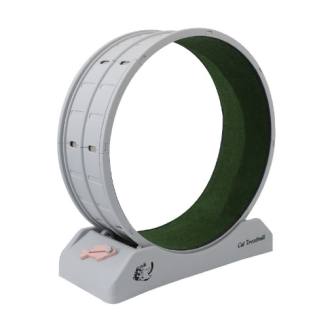
Indoor cats need a way to burn energy, and their owners know it. A cat that races around the house at 3 a.m. is a customer with a problem, and an exercise wheel is the most visible answer a pet store can offer. It is a big, confident product: it says enrichment, it says premium, and it turns a corner of your shop into a conversation.
For a retailer, wheels are a different kind of sale from a ball or a wand. The ticket is higher, the customer has usually done some research before walking in, and the decision is made on trust — trust in your advice, and trust that the wheel will actually get used. This guide covers the two kinds of wheel on the market, what to check before you order, and how to build a small range that sells.
1. Two kinds of wheel: full-size exercise wheels and spinning toys
Most stores confuse the two, and the confusion costs sales. A full-size exercise wheel, like our Cat Exercise Wheel (PL021), is a large wheel the cat runs inside. It is built for real exercise: an active indoor cat, a multi-cat household, or an owner whose cat has more energy than the living room can absorb.
A spinning wheel toy is a different product entirely. It sits on the floor or a table, and the cat bats at a wheel or ball that spins. Our Cat Spinning Wheel (PL002), Whale Cat Spinning Wheel (PL003) and Upside-Down Cat Spinning Wheel (PL005) all work this way. They are compact, affordable, and easy to explain — the cat plays with it the moment it sees it.
Stock both, and sell them to different buyers. The spinning toy is the everyday sale: any cat household, any budget, no floor space needed. The full-size wheel is the destination sale: the customer who came in for one, or the customer who sees your display wheel and realises it solves their 3 a.m. problem.
2. What to check before you order a full-size wheel
A full-size wheel is the largest toy most stores will ever stock, so check the practical details before you commit.
First, the footprint. Measure the wheel, then measure the floor space you can give it — and remember the customer needs the same space at home. A wheel that looks fine in a warehouse photo can dominate a small living room, so be ready to tell the customer the real dimensions.
Second, stability. A wheel only works if it stays put while a cat runs in it. Check the base: it should sit flat, feel heavy for its size, and not rock when pushed from the side. Ask your supplier how the wheel is packed and whether it needs assembly — a wheel that arrives in pieces needs clear instructions, and staff should have built one themselves before they sell one.
Third, the running surface. It should give the cat grip without catching claws, and it should be easy to wipe clean. A surface that is hard to clean will come back as a complaint, because a wheel that smells of old use is a wheel that stops being used.
3. Noise, and the two questions customers always ask
After price, the two questions every customer asks are “Is it noisy?” and “Will my cat actually use it?”
On noise, be honest: any wheel with moving parts makes some sound, and the sound depends on how the wheel is built and how fast the cat runs. A well-made wheel runs quietly at a walk and louder at a sprint. Customers who put the wheel on a hard floor will hear more than customers who put it on a rug. Set that expectation at the counter and you avoid the “it got loud” return.
On whether the cat will use it, the honest answer is that most cats need time. A cat will not hop on a new wheel on day one. Tell customers to place the wheel where the cat already plays, leave it still for a few days, and use a favourite toy or treat to lure the cat onto it. Cats that like to chase and climb take to wheels fastest. Never force a cat onto a wheel, and keep kittens and older cats supervised until they are confident.
4. Building the assortment: three slots cover the category
A practical starter range needs only three slots. First, one full-size exercise wheel as the hero — the product the display is built around. Second, a compact spinning wheel for the everyday buyer who wants enrichment without the footprint. Third, a fun variant, like the whale-shaped spinning wheel, for the customer buying a gift or a second toy.
Keep the range small on purpose. Wheels are a category where too many similar models confuse the customer and slow the sale. Three clear choices — hero wheel, compact spinner, and a playful variant — let staff explain the difference in one sentence each.
Put the hero wheel on the floor, assembled and ready to touch. If you can, run a short video loop beside it showing a cat using one. Customers buy wheels with their eyes first: they need to see a cat running, not read a spec sheet.
5. Selling wheels alongside the rest of the enrichment range
Wheels sell best when they sit with the enrichment range, not on their own. A customer looking at a wheel is a customer who already cares about keeping an indoor cat busy — the same customer who buys interactive balls, lick mats and teaser wands. Place the spinning wheel toys next to those, and the hero wheel at the end of the same aisle, so the small sale leads naturally to the big one.
Train staff on one line each: the spinning toy is for play, the exercise wheel is for energy. That distinction is the whole pitch, and it is short enough to remember on a busy Saturday.
Want the full range before you decide? Browse our wholesale toys — including the Cat Exercise Wheel (PL021) and the Cat Spinning Wheel range (PL002, PL003, PL005) — or request a quote and tell us which models you want priced. Pricing and MOQ are available on request.